How to Calculate BMI (and What the Number Actually Means)
How to calculate BMI in metric and imperial units, a full worked example, and a clear-eyed look at what the number does and does not measure.
JCVerified Verified by Jobi Cheriyan, Founder & Builder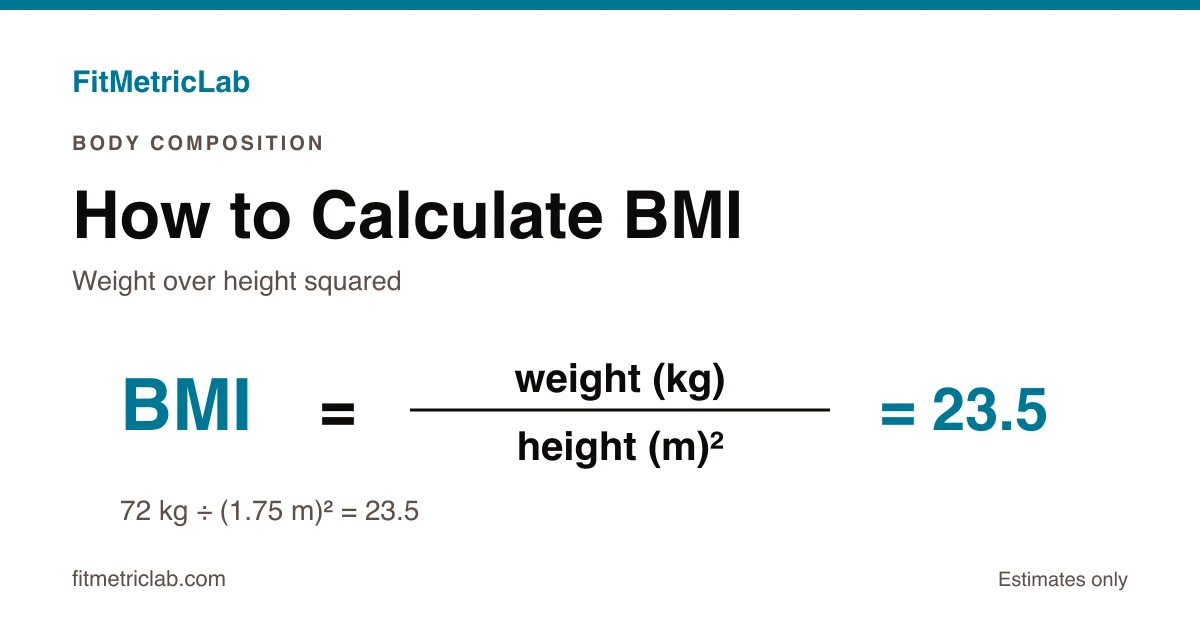
Step on the scales at 72 kg (159 lb), stand 1.75 m (5 ft 9 in) tall, and one short sum turns those two numbers into a BMI of 23.5. That is really all BMI is: a way of relating your weight to your height. The BMI calculator works it out in a second, but the number is worth understanding, because it tells you less than most charts suggest.
Learning how to calculate BMI by hand needs nothing more than a set of scales and your height. This guide walks through the formula in plain language, shows a full worked example in both metric and imperial units, and is honest about what the figure can and cannot tell you, so the reading you get is one you can actually make sense of.
What BMI is
Body mass index, or BMI, is a single number that compares your weight against your height. You get it by dividing weight in kilograms by height in metres squared, which gives a value in kg/m². Squaring the height is what lets you compare a tall person and a short one on roughly the same scale, since a taller person is expected to weigh more. It helps to think of BMI as a screening ratio rather than a measurement of the body itself. It estimates where you sit relative to a large population, and it does that from just two numbers almost anyone can gather.
Why the BMI number matters
BMI became popular for a simple reason: it is cheap, quick, and needs only a set of scales and something to measure height. Across large groups of people it tracks loosely with how much body fat they carry, which makes it a handy first check when measuring body composition directly would be slow or expensive. Doctors, public-health teams and researchers use it to describe whole populations, spot trends over time, and set the reference ranges most of us have seen.
The problem is that a tool built for populations often gets used on individuals. A ratio that behaves sensibly when you average it over thousands of people can be misleading for a single weightlifter, a pregnant woman, an older adult who has lost muscle, or a growing child. Treat the number as a rough signal, quick to work out again whenever your weight changes, and it stays useful without being asked to do more than it can.
How to calculate BMI
The BMI formula is a single division: take your weight in kilograms and divide it by your height in metres multiplied by itself. That is it. Squaring the height is what lets the ratio compare tall and short people fairly, because across a population weight tends to rise roughly with the square of height rather than with height alone.
BMI = weight (kg) / ( height (m) x height (m) )

Imperial: BMI = 703 x weight (lb) / ( height (in) x height (in) )
Where:
- weight = body mass in kilograms (kg), or pounds (lb) in the imperial version
- height = standing height in metres (m), or inches (in) in the imperial version
- 703 = the conversion factor that brings the pound-and-inch result in line with the metric one
Both versions are the same calculation in different units, so if you enter your numbers correctly in either system you get the same BMI. The detail that trips most people up is height: it goes in as metres (1.75), not centimetres (175).
A worked example
Take someone who weighs 72 kg (159 lb) and stands 1.75 m (5 ft 9 in) tall. In metric, square the height first: 1.75 multiplied by 1.75 gives 3.0625 m². Then divide the weight by that figure: 72 divided by 3.0625 comes to 23.5.
| Step | Metric | Imperial |
|---|---|---|
| Weight | 72 kg | 159 lb |
| Height | 1.75 m | 69 in |
| Height squared | 3.0625 m² | 4761 in² |
| Apply the formula | 72 ÷ 3.0625 | 703 × 159 ÷ 4761 |
| BMI | 23.5 | 23.5 |
It is worth checking the same person in imperial units. A height of 1.75 m is about 69 in (68.9 in), and 72 kg is about 159 lb. So the sum becomes 703 multiplied by 159, then divided by 69 squared, which also comes out at roughly 23.5. That matches the metric answer and confirms the arithmetic. Only the final figure is rounded; keeping the steps in between unrounded is what makes the two systems agree.
A BMI of 23.5 falls inside the range the World Health Organization calls a healthy weight, which runs from 18.5 to 24.9. That tells you where the reading sits on a population reference scale, and nothing more about this particular body's muscle, fat or build.
- Underweight < 18.5
- Healthy 18.5–24.9
- Overweight 25–29.9
- Obesity ≥ 30
| Category | BMI range (kg/m²) |
|---|---|
| Underweight | Below 18.5 |
| Healthy weight | 18.5 – 24.9 |
| Overweight | 25.0 – 29.9 |
| Obesity | 30.0 and above |
How to use the BMI calculator
Once you can work BMI out by hand, the BMI calculator simply automates it. It needs two things: your height and your weight. A unit switch lets you enter height in metres or centimetres, or in feet and inches, and weight in kilograms, pounds, or stone and pounds, which is handy because the UK and Ireland still weigh people in stone while most of the world uses kilograms. Put your numbers in whichever units suit you and the tool converts them for you.
What comes back is the BMI value itself plus the reference band it falls into. Read the number as a zone, not a precise score: a reading of 24.9 and one of 25.1 differ more because of rounding than because of any real difference in the body. Since the only inputs are weight and height, the result updates the moment either changes, which makes it easy to follow a trend over months instead of fixating on a single reading.
Common scenarios
A distance runner logging metrics abroad
A runner who normally thinks in kilograms travels somewhere that quotes weight in pounds. Entering 159 lb and 5 ft 9 in gives the same 23.5 as their usual 72 kg and 1.75 m, because the calculator converts everything internally. The one rule to remember is to pick a single system for each calculation rather than mixing a metric height with an imperial weight.
A strength athlete carrying heavy muscle
A powerlifter at 95 kg (209 lb) and 1.78 m (5 ft 10 in) gets a BMI of almost 30, right at the edge of the obesity band, yet may carry very little fat. BMI cannot see muscle, so pairing it with a body fat percentage (navy method) estimate gives a much fuller picture than weight alone.
Tracking BMI alongside energy numbers
Someone tracking their numbers over a season often reads BMI alongside a BMR calculator (Mifflin-St Jeor) figure and a TDEE calculator estimate, both in kilocalories (kcal, the same unit shown as kilojoules, or kJ, on many food labels outside the US). BMI describes your shape relative to your height; the energy tools describe how much your body burns. Read together, they tell you something neither can on its own.
Comparing two people of different heights
A person of 1.60 m (5 ft 3 in) and one of 1.90 m (6 ft 3 in) at the same weight land at very different BMIs, because the squared-height term adjusts for stature. That is the ratio doing exactly what it is meant to, not a mistake.
Common mistakes and misconceptions
- Treating an estimate as a diagnosis. BMI is a screening ratio built for populations. A single reading places you on a reference scale; it does not diagnose anything, and it is not a verdict on your health.
- Mixing units mid-calculation: dividing pounds by metres, or forgetting the 703 factor in the imperial version, gives a meaningless number. Keep every input in one system.
- Using centimetres instead of metres. Entering 175 instead of 1.75 for height shrinks the result to a fraction of its real value. In the standard formula, height goes in as metres.
- Confusing BMI with body fat. The formula contains no term for fat and cannot measure it. A body fat percentage (navy method) estimate answers that question; BMI does not.
- Applying adult bands to everyone. The WHO adult bands are not meant for children, who are assessed on age-and-sex percentile charts, and they flatter neither very muscular nor very frail bodies.
Frequently asked questions
What is a healthy BMI range?
The World Health Organization sorts adult BMI into bands: below 18.5 is underweight, 18.5 to 24.9 is a healthy weight, 25.0 to 29.9 is overweight, and 30.0 or above is obesity. These are population-level reference points drawn from large groups, not a judgement on any one person. Near a boundary, a small change in how you enter your height or read the scales can tip you across a line, so it is best to treat each band as a rough zone rather than a hard label. Two people with the same BMI can carry very different amounts of muscle and fat, which is why the number is a starting signal, not a conclusion.
Is BMI accurate for athletes and muscular people?
BMI uses only weight and height, so it cannot tell muscle from fat. A lifter or sprinter carrying a lot of lean tissue is heavy for their height and can land in the overweight or obesity band while carrying very little fat. The formula is not wrong; it is simply measuring something narrower than people assume. For anyone whose training builds real muscle, BMI on its own tends to overstate things, which is why it is often read alongside a body fat percentage (navy method) estimate or girth measurements that describe composition rather than raw weight.
How do I calculate BMI in pounds and inches?
The imperial version multiplies weight in pounds by 703, then divides by height in inches squared. For 159 lb at 69 in, that is 703 times 159, divided by 69 squared, which comes to roughly 23.5, the same figure the metric formula gives for 72 kg at 1.75 m. The 703 factor is there purely to bring pounds and inches onto the same scale as the metric kilogram-and-metre version. Mixing the two systems, such as dividing pounds by metres, is the most common cause of a wildly wrong reading, so keep every input in one system.
Does BMI measure body fat?
No. BMI is a ratio of weight to height and never touches fat directly. It correlates loosely with body fat across large populations, which is why health bodies use it for screening, but for a single person it says nothing about how much fat there is or where it sits. Two people at the same BMI can differ sharply in fat, muscle and build. To describe composition rather than weight, a body fat percentage estimate or a simple waist measurement carries information BMI structurally cannot, because the formula has no term for anything but weight and height.
Sources and methodology
The formula and worked example above were checked by hand in both metric and imperial units, and both return 23.5, while the reference bands follow the World Health Organization's adult classification. The 703 constant in the imperial version is the standard factor that brings pounds and inches in line with the metric result.
- World Health Organization. Reference bands and the BMI definition
- Keys et al. (1972), "Indices of relative weight and obesity". The peer-reviewed paper that established the body mass index term
Putting it together
Learning how to calculate BMI comes down to one division: weight divided by height squared. The BMI calculator returns the figure the moment you enter two numbers, and the worked example shows the metric and imperial versions landing on the same 23.5, which is the reassuring part, because the maths is simple and repeatable. Interpretation is the harder part. BMI is a population screen that says nothing about muscle, fat, or where weight sits on your frame, so it works best as one signal among several rather than a score on its own. Taken that way, quick to check and easy to repeat, it is a useful way into the wider set of body-composition numbers.
Last updated 21 July 2026.