How Many Calories Does Swimming Burn?
Swimming calorie burn comes from a MET value, body mass and duration. This guide works the formula through step by step, corrects the widespread mistake of rating breaststroke below freestyle, and shows where the estimate stops describing water.
JCVerified Verified by Jobi Cheriyan, Founder & Builder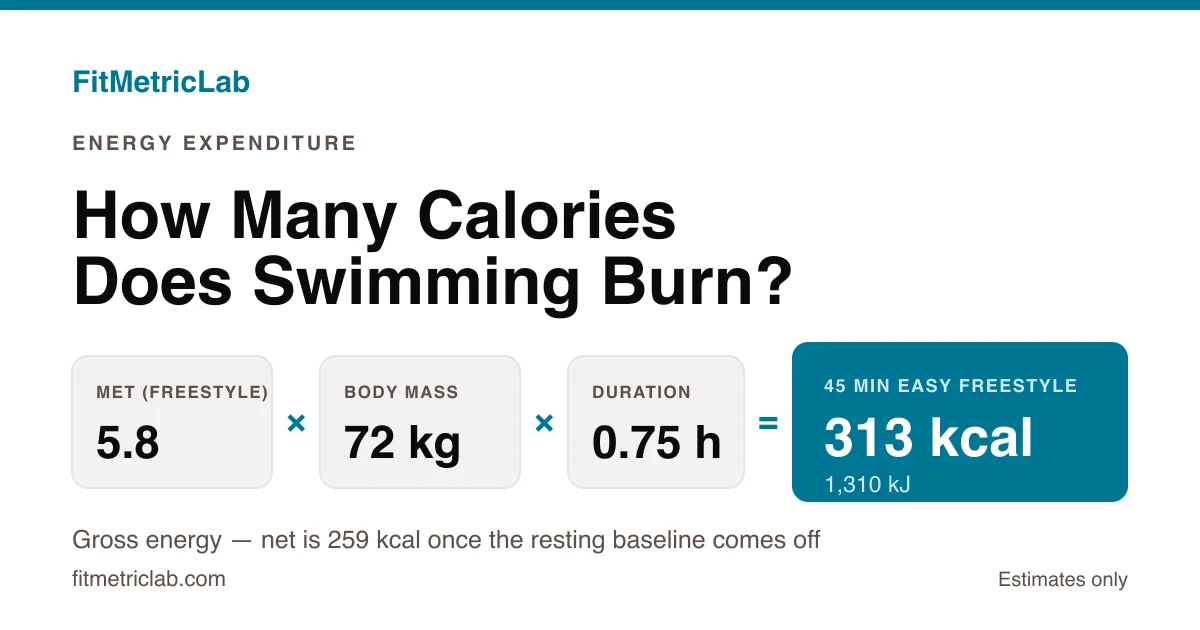
A 72 kg (159 lb, 11 st 5 lb) swimmer doing 45 minutes of easy freestyle uses about 313 kcal: 1,310 kJ. Same swimmer, same pool, same 45 minutes, held instead at a hard sustained crawl: roughly 529 kcal (2,214 kJ). Nothing changed except how hard they swam.
That 216 kcal gap is why how many calories does swimming burn has no clean one-line answer, and why the inputs behind the figure deserve more attention than the figure itself. What follows is where the number comes from, what it is honestly measuring, and the specific places the model stops describing water. The Calorie Burn: Swimming calculator runs the same equation used throughout this article, so the worked example below can be reproduced in it directly.
What a swimming calorie estimate actually measures
It is a model of the energy your body uses while you are in the water, reported in kilocalories or kilojoules depending on where you live. Food labels across the EU, the UK, Ireland, Australia and New Zealand print both. Labels in the United States and Canada print Calories with a capital C, which is the same quantity as one kilocalorie. One kcal is 4.184 kJ, and none of the underlying maths changes from one country to the next.
Underneath the estimate sits a MET value. Metabolic equivalent of task. It is a ratio, not a unit of energy. One MET is roughly the cost of sitting quietly. An activity listed at 9.8 METs costs about 9.8 times that.
The word "about" is doing real work in that sentence. MET values come from laboratory testing using indirect calorimetry, averaged across groups of participants and compiled into the Compendium of Physical Activities. The compilers are candid about the limits of their own table: it was built so that different studies could compare activities on one scale, not to pin down what one named person burned on a Tuesday morning. A calorie estimate for your swim is exactly that second kind of use.
Why swimming has no single answer
Every activity has a spread around its published MET value. Swimming has a wider spread than most, and the reasons are worth understanding before trusting any figure.
Start with drag. Water is roughly 800 times denser than air, so resistance dominates a swimmer's energy account in a way it never does for someone jogging on flat ground. Drag force climbs with the square of speed, and the power needed to overcome it climbs faster still, closer to the cube. Small gains in pace are expensive.
Then there is technique, which swimming research measures as propelling efficiency: the share of muscular work that actually moves the body forward instead of stirring water sideways. The gap between a beginner and a trained swimmer here is enormous, and it produces a result most people find backwards. The less efficient swimmer frequently burns more energy per length while covering the length more slowly. Effort and output come apart in water in a way they largely do not on land.
Body composition adds another layer. Fat tissue is less dense than water and floats, so two people of identical mass can sit at noticeably different heights, present different frontal area and pay different drag costs at the same speed. The research literature treats the energy cost of swimming as the outcome of two things: hydrodynamic drag and propelling efficiency. Trunk incline (the angle at which the body sits in the water) is one of the measured contributors to the first of those, and it is not something a calculator can ask about.
Water temperature matters as well, since water pulls heat from skin far faster than air at the same reading on the thermometer.
None of those four variables appears anywhere in the equation. They live inside the scatter that a published average has already flattened. That is the honest case for reading the output as a band rather than a figure.
How swimming calorie burn is calculated
FitMetricLab's tools use the Compendium's own conversion, which is about as plain as sports science gets:
Energy (kcal) = MET × body mass (kg) × duration (hours)

Net energy (kcal) = (MET − 1) × body mass (kg) × duration (hours)

Energy (kJ) = kcal × 4.184
Where:
- MET, the intensity value for the stroke and effort, unitless, read off a published table.
- Body mass. In kilogrammes. From pounds, divide by 2.205; from stone, multiply by 6.35.
- Duration: time actually swimming, in hours. Forty-five minutes is 0.75.
The whole thing rests on the definition that one MET equals 1 kcal per kilogram of body mass per hour. Sit still for an hour at 72 kg and you use roughly 72 kcal. Swim at 5.8 METs for that hour and you use roughly 5.8 times as much.
The swimming MET value is the only term you cannot measure for yourself, so it comes from the table. The 2024 Adult Compendium lists swimming under Water Activities, split by stroke and by described effort:
- Freestyle laps, slow, recreational: 5.8 (code 18240)
- Crawl, slow, 30–45 yd/min, moderate effort: 5.8 (18292)
- Crawl, medium, ~50 yd/min, vigorous effort: 8.0 (18290)
- Freestyle laps, fast, vigorous effort: 9.8 (18230)
- Crawl, fast, ~75 yd/min, vigorous effort: 10.5 (18280)
- Crawl, elite competition, >90 yd/min: 14.5 (18294)
- Breaststroke, recreational: 5.3 (18265)
- Breaststroke, training or competition: 10.3 (18260)
- Backstroke, recreational: 4.8 (18255)
- Backstroke, training or competition: 9.5 (18250)
- Butterfly, general: 13.8 (18270)
- Sidestroke, general: 7.0 (18320)
- Treading water, moderate effort: 3.5 (18350)
- Treading water, fast, vigorous effort: 9.8 (18340)
- Open water, 5 km: 10.5 (18285)
- Lake, ocean or river swimming, general: 6.0 (18300)
- Leisurely, not lap swimming: 6.0 (18310)
Two entries in that list deserve a second look. Butterfly at 13.8 is the most expensive stroke on the table by a wide margin: for scale, the same Compendium rates running at 9 mph (14.5 km/h) at 13.0 and running at 10 mph (16 km/h) at 14.8, so butterfly sits between the two.
The second is competitive breaststroke at 10.3, which sits above fast freestyle at 9.8 and runs against the common belief that breaststroke is the gentle option. Both breaststroke rows exist, five METs apart. Choosing the wrong one is the largest single error available in this calculation.
A worked example, step by step
Priya weighs 72 kg (159 lb) and swims 45 minutes of steady freestyle at about 40 yd/min. Roughly 0.6 m/s, or 2:44 per 100 m and 2:30 per 100 yd. That covers 1,800 yd, which is 1,646 m, in a pool held near 26 °C (79 °F): whether her pool measures 25 m or 25 yd changes the lap count, not the energy.
- Find the row. Thirty to forty-five yards a minute at moderate effort is code 18292, which carries 5.8 METs. The recreational freestyle laps entry lands on the same value.
- Convert duration to hours. 45 ÷ 60 = 0.75.
- Multiply the three terms. 5.8 × 72 × 0.75 = 313.2 kcal.
- Round once, at the end. 313 kcal, or 1,310 kJ.
Spread across 1,646 m that works out at roughly 19 kcal per 100 m: a useful figure to carry around, since most swimmers count distance rather than minutes. Calories burned swimming laps scale cleanly on that basis for as long as the pace holds.
For the net version, run the same sum at 1 MET: 1 × 72 × 0.75 = 54 kcal of resting baseline. Subtract that and 259 kcal (1,084 kJ) is attributable to the swimming itself.
Now hold everything constant and move only the MET value. At 9.8, the fast vigorous freestyle row, the same 45 minutes returns 529 kcal (2,214 kJ): 69% higher, which is simply the ratio 9.8 ÷ 5.8. Swim it as competitive breaststroke at 10.3 and it reaches 556 kcal (2,327 kJ). Stay at the easy pace but stretch the session to a full hour and it lands at 418 kcal (1,747 kJ).
Body mass and duration are both straight multipliers, and both are things you can measure. Every bit of genuine uncertainty in the answer sits in that one lookup.
Why two honest calculators disagree on the same swim
Enter identical inputs into two well-sourced tools and the answers can differ by a fifth. There are two reasons, and neither involves anyone being wrong.
The first is definitional. The Compendium defines one MET two ways on the same reference page: as 1 kcal per kilogram per hour, and as an oxygen uptake of 3.5 millilitres per kilogram per minute.
Follow the oxygen route: 3.5 ml/kg/min is 0.21 litres per kilogram per hour, and each litre of oxygen releases about 5 kcal, and you get 1.05 kcal/kg/h, not 1.00. Any calculator built on that definition returns figures exactly 5% higher from identical inputs. Priya's 313 kcal becomes 329 kcal, with no error anywhere.
The second reason is bigger. "Vigorous freestyle" maps to at least three different rows: 8.0 for medium-speed crawl, 9.8 for fast laps, 10.5 for crawl at roughly 75 yards a minute. For Priya's 45 minutes those give 432, 529 and 567 kcal. That is a 31% spread before the definitional 5% is layered on top, and every value in it comes from the same peer-reviewed table.
Which is why "around 300" is a more truthful reading of 313 kcal than 313 is, and why comparing two of your own sessions from one calculator carries far more information than comparing one session across two apps.
How to use the Calorie Burn: Swimming tool
The swimming calories burned calculator takes three inputs: body mass, session duration in minutes, and an intensity setting. There is a metric/imperial toggle, so pounds work as well as kilogrammes. It returns a single gross figure in kilocalories, and shows the MET value it used alongside the result so the arithmetic stays visible.
The intensity setting carries the whole intensity signal, and it maps onto three of the freestyle rows above: Light is 5.8 METs, Moderate 7.0, Vigorous 9.8. Duration means active minutes: lane waiting, kit changes and the conversation at the shallow end sit far closer to resting metabolism than to any stroke row.
Two limits are worth knowing before reading the output. There is no stroke field, so the breaststroke, butterfly and backstroke values discussed above cannot be selected directly. For those, the custom activity MET calculator accepts a MET value straight from the table, which is the route to costing a butterfly set at 13.8 or a training breaststroke at 10.3. And the output is kilocalories only: multiply by 4.184 for kilojoules, and run the sum again one MET lower for the net figure.
A habit that turns a point value into something more honest: run the calculation twice, once on the setting below the one chosen and once on the setting above. The spread between them is the realistic range for the session.
How many calories does swimming burn in different sessions?
A masters swimmer on a mixed stroke set
Take an hour split four ways: 10 minutes of butterfly at 13.8 METs, 20 minutes of easy freestyle at 5.8, 20 minutes of recreational backstroke at 4.8, and 10 minutes of treading at 3.5. The Compendium's own guidance asks users not to blend activities carrying different MET levels into a single average, so each block is costed on its own and the results added: 166 + 139 + 115 + 42 = 462 kcal (1,933 kJ) for a 72 kg swimmer.
Applying the butterfly rating across the whole hour would have returned 994 kcal: more than double, and plainly wrong. Mixed sessions have to be costed block by block or the total drifts badly.
An interval set of 400 m repeats
Hard repeats with easy lengths between them present the same problem in miniature. The work portions may well justify 9.8 or 10.5, but the recovery lengths sit nearer 5.8, and the rest at the wall sits nearer 1. Timing the hard portions separately and adding them to a lower-rated remainder produces a figure that survives scrutiny; rating the whole hour at the hardest interval does not.
Open water in cold conditions
A 1,500 m (1,640 yd) lake swim at 16 °C (61 °F) carries thermoregulatory costs that pool-derived values simply omit. Shivering and raised heat production add real energy expenditure with no term to represent it.
Worth knowing too: the Compendium's general lake, ocean and river entry sits at 6.0 METs whatever the conditions, with nothing in it for temperature, chop or current. Estimates for cold open water therefore sit low, and the direction of that error is known even where its size is not.
A beginner learning front crawl
A first month in the water is mostly stops, drills and treading. Treading at moderate effort is 3.5 METs, against 5.8 for easy continuous freestyle and 9.8 for the vigorous row, so a session that leaves someone genuinely wrecked can return a modest total. Perceived exertion and metabolic cost diverge sharply for beginners, partly because poor propelling efficiency makes hard work of slow progress. That is the model behaving correctly, not failing.
Comparing swimming against other training
Cross-training decisions usually turn on matched energy cost at different joint loading, which is exactly what the MET scale was designed for. Running the same body mass and duration through the rowing calorie burn calculator or the running calorie burn calculator puts three modalities on one scale, and the activity calorie comparison calculator lines several up at matched duration. The comparison only holds when effort bands are matched honestly on both sides.
Common mistakes and misconceptions
- Picking the wrong row for the stroke. Recreational breaststroke is 5.3 METs and training breaststroke is 10.3. Backstroke splits 4.8 against 9.5. Getting that choice wrong roughly doubles or halves the answer, which dwarfs every other error on this list.
- Treating the estimate as a measurement. The output is a model built on a population average. Reporting it to the nearest kilocalorie claims a precision the method has never had.
- Double counting resting metabolism. Setting a gross session figure against a daily maintenance estimate counts the resting portion twice, because maintenance already contains it. The net variant exists for that comparison.
- Mixing mass units. Typing 159 into a kilogram field instead of 72 inflates the result by 121%. Stone is still in everyday use across parts of the UK and Ireland, which adds a third unit to the muddle.
- Counting poolside time as swimming time. Rest intervals and lane queues belong nowhere near the selected effort row.
- Reading kilojoules as kilocalories. 1,310 and 313 describe the same session. Mistaking one for the other overstates energy by a factor of 4.184.
Frequently asked questions
How many calories does swimming burn in an hour?
For a 72 kg (159 lb) swimmer at easy recreational freestyle, rated 5.8 METs, an hour returns about 418 kcal (1,747 kJ). At the fast vigorous freestyle row of 9.8 METs the same hour reaches roughly 706 kcal. A lighter swimmer returns proportionally less, because body mass is a straight multiplier. Both figures are worth treating as bands rather than point values, and there is a practical catch: a full hour of continuous swimming is rare outside distance training. Most pool sessions mix work, recovery and drill segments that pull the session average well below the headline row.
Does swimming burn more calories than running?
Minute for minute they land close together, and the ranking flips with the effort level each is set to. The 2024 Compendium rates fast vigorous freestyle at 9.8 METs and running at 6 to 6.3 mph (roughly 10 km/h, 6:00 min/km) at 9.3, so 45 minutes at 72 kg gives 529 kcal swimming against 502 kcal running. Near enough that energy cost alone separates them very little. Older published tables put that running pace at 9.8, which is why figures differ between sources; the companion running post covers that split. The real difference lies elsewhere. Water supports body mass, so joint loading differs sharply at matched cost, and technique moves the swimming figure far more than it moves the running one. An inefficient swimmer generates drag and burns energy without covering distance, and no MET table can see it.
Does cold water burn extra calories when swimming?
Immersion below thermal neutral temperature raises heat loss, because water moves heat away from skin far faster than air at the same temperature, and shivering plus raised metabolic rate follow. The published swimming values, though, come largely from pool testing at comfortable temperatures near 26 °C (79 °F), so they carry no thermal term at all. An estimate produced for a lake swim at 16 °C (61 °F) therefore sits low against actual expenditure: how far low varies with body composition, wetsuit use and acclimatisation, none of which the equation can represent.
Does breaststroke burn more calories than freestyle?
At training intensity, yes, which surprises most people. The 2024 Compendium puts breaststroke at 10.3 METs for training or competition, above fast freestyle at 9.8. The high-drag body position and the powerful kick make it expensive. But the same table lists recreational breaststroke at just 5.3, so the stroke label alone predicts almost nothing; the effort description attached to it does the work. Butterfly at 13.8 tops the list regardless of how it is described. In practice a strong specialist working hard on any stroke outspends a novice thrashing through another.
Should a swimming calorie estimate be gross or net?
Gross counts all the energy used during the session, including the resting metabolism that would have ticked over anyway. Net subtracts that baseline by dropping one MET before the arithmetic runs. For the worked example above, gross is 313 kcal (1,310 kJ) and net is 259 kcal (1,084 kJ) for the identical swim. Neither is wrong, and the choice depends on what the number sits beside. Comparing a session against an energy intake target usually calls for the net figure, since a daily maintenance estimate already contains the resting portion.
Sources and methodology
The swimming MET values quoted here come from the Water Activities table of the 2024 Adult Compendium of Physical Activities, and the running comparisons from its Running table, the third major update to a reference first published in 1993. That update was tailored to adults aged 19 to 59 and replaced estimated values with measured ones wherever the literature allowed: 82% of its entries now carry measured MET values, against 68% in the 2011 edition, and the compilers flag which is which in the online tables.
Energy figures use the Compendium's kilocalorie definition of the MET, so that one MET equals 1 kcal per kilogram per hour. The alternative oxygen definition returns figures 5% higher, as set out earlier. Kilojoule conversions use the thermochemical factor of 4.184 kJ per kcal. Every number in the worked example and the scenarios was recomputed from the raw equation rather than copied from a published table, and rounding is applied once, at the end.
Reference sources:
- 2024 Adult Compendium of Physical Activities, Water Activities
- Compendium of Physical Activities, MET definitions and usage guidance
- Herrmann SD et al. 2024 Adult Compendium of Physical Activities, Journal of Sport and Health Science
- Zamparo P, Cortesi M, Gatta G, The energy cost of swimming and its determinants, European Journal of Applied Physiology
- World Health Organization, physical activity fact sheet
Putting it together
So: how many calories does swimming burn? It comes down to one equation with a single genuinely uncertain input. Body mass and duration are things you can measure.
The swimming MET value stands in for stroke, speed, technique, buoyancy and water temperature all at once, and that is where the entire spread lives. Moving one row shifted the worked example from 313 kcal to 529 kcal without touching anything else, and the breaststroke rows move it further still.
The practical consequence is small and worth keeping. Running the calories burned swimming calculator on the settings either side of a session produces a range instead of a false point value, and a range tracked consistently across a training block shows a trend that no single figure ever will. The same logic applies across activities, which is covered in more depth in the companion piece on how many calories running burns.
Last updated 5 August 2026.