How to Convert Running Pace Between min/mile and min/km
A mile is exactly 1.609344 km, so converting a pace is one division. The seconds are where it goes wrong. 8:30 per mile is worked through to 5:17 per kilometre, with a two-way reference table and the shortcuts that cost over a minute across a marathon.
JCVerified Verified by Jobi Cheriyan, Founder & Builder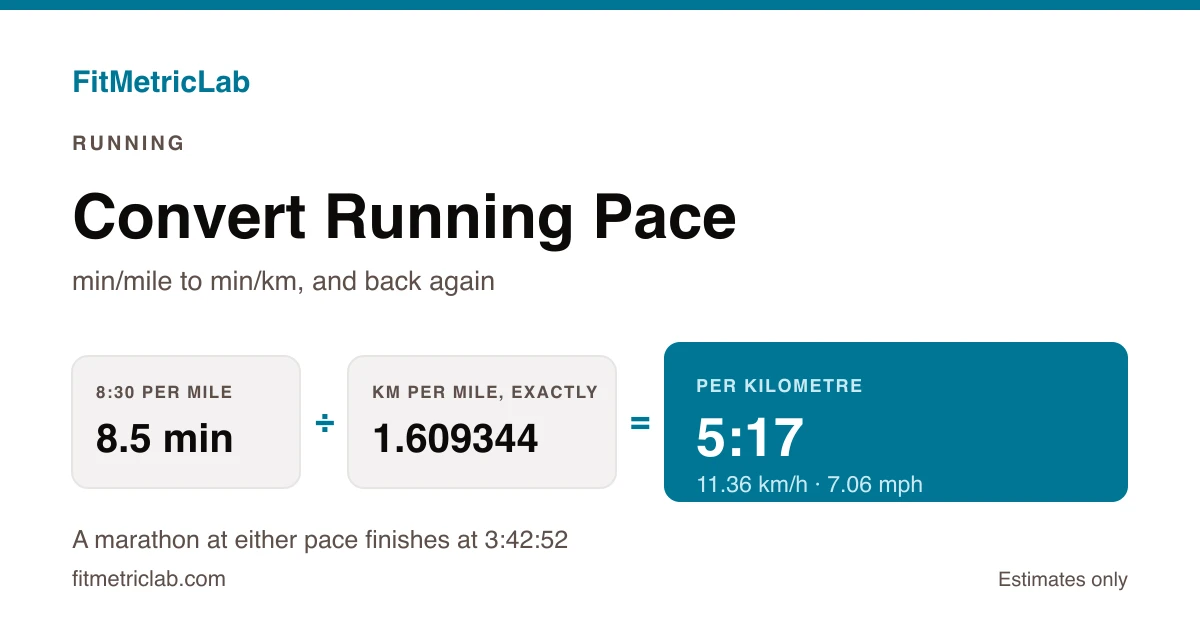
A watch reading 8:30 per mile and a plan written at 5:15 per kilometre look like unrelated numbers. They are almost the same running: 8:30 per mile is 5:17 per kilometre, making the plan two seconds a kilometre quicker. To convert min per mile to min per km you divide by 1.609344, and the pace converter (min/mile to min/km) runs it both ways from one entry.
What it means to convert min per mile to min per km
Pace states a time for one unit of distance, which makes the unit part of the measurement rather than a label stuck on the end of it. One mile measures 1.609344 kilometres, so a runner holding one steady speed spends about 61 per cent longer covering a mile than a kilometre. The min/mile figure is always the larger of the two.
Converting between the two units restates one speed in the other. Nothing about the running changes. The yardstick shrinks, and the number on the clock shrinks with it, in the same proportion every time.
Why running carries two pace units at once
Competitive distances are metric almost everywhere: a track lap of 400 metres (437 yards), road races at 5 km (3.11 miles) and 10 km (6.21 miles), a marathon of 42.195 km (26.22 miles). None is round in miles, which is the first clue about which side the courses were measured in.
Everyday running is another story. The United States runs in miles, the UK and Ireland post road signs in miles and stage races in kilometres, and the rest of the English-speaking world sits mostly metric. Spelling drifts too: metre and kilometre are the international spellings used here, meter and kilometer the American ones, and a 5 km event is a 5K to most people who enter it.
How the conversion is calculated
One factor, one decision about which way to point it. A mile contains 1.609344 kilometres, so a pace measured per mile covers that many times more ground per tick of the clock. Dividing moves a pace to min/km. Multiplying goes back.
The awkward part sits elsewhere. Pace is written in minutes and seconds, base sixty, while the division is decimal. A pace of 8:30 per mile is 8.5 decimal minutes, not 8.30, and feeding the written form into a calculator is the commonest way this fails.
pace_min_per_km   = pace_min_per_mile / 1.609344
pace_min_per_mile = pace_min_per_km   * 1.609344

MM:SS to decimal minutes
decimal_minutes = MM + (SS / 60)

decimal minutes back to MM:SS
MM = whole part of decimal_minutes
SS = (decimal_minutes - MM) * 60- pace_min_per_mile: pace in decimal minutes per mile (min/mile).
- pace_min_per_km: pace in decimal minutes per kilometre (min/km).
- 1.609344: kilometres in one international mile (km per mile), exact by definition, carrying no error of its own.
- MM: whole minutes on the clock. SS: seconds, 0 to 59.
A worked example
Take 8:30 per mile. The seconds go first: 30 divided by 60 is 0.5, so the pace is 8.5 decimal minutes per mile.
Divide. 8.5 divided by 1.609344 returns 5.281655134 minutes per kilometre, and every digit stays for now, because the rounding belongs at the end. The whole part is 5 minutes; the tail, 0.281655134, multiplied by 60 gives 16.8993 seconds. Rounded once, at the finish: 5:17 per kilometre (8:30 per mile).
Multiplying 5.281655134 back by 1.609344 returns 8.5 exactly, so nothing leaked out. A distance check convinces harder. Over a marathon, 42.195 km at 5.281655134 min/km is 222.8594 minutes, or 3:42:52; the same marathon in miles is 26.218757 miles, and 26.218757 times 8.5 is 222.8594 minutes again. Identical to the second, from two different distance figures.
A two-way reference table
Round paces in one unit land on awkward figures in the other. Values are rounded to the nearest second.
| min/mile | equals min/km | min/km | equals min/mile |
|---|---|---|---|
| 6:00 | 3:44 | 4:00 | 6:26 |
| 7:00 | 4:21 | 4:30 | 7:15 |
| 8:00 | 4:58 | 5:00 | 8:03 |
| 9:00 | 5:36 | 5:30 | 8:51 |
| 10:00 | 6:13 | 6:00 | 9:39 |
| 11:00 | 6:50 | 6:30 | 10:28 |
| 12:00 | 7:27 | 7:00 | 11:16 |
A minute of difference in min/mile is about 37 seconds in min/km, which is why paces in the two units are never comparable by eye.
How to use the Pace Converter (min/mile to min/km)
The min/mile to min/km pace converter holds one field per unit. Fill the one you have, leave the other blank, and the conversion runs in that direction. Fill both and the min/km field takes precedence.
Both fields want decimal minutes rather than clock time, so 8:30 per mile is entered as 8.5. That is the one step the tool leaves to the reader, and it is the same step the section above names as the commonest failure. There is a safeguard worth knowing about: the result echoes back the pace it actually read, so a typed 8.30 returns labelled as 8:18 per mile rather than 8:30, which is the moment to catch it.
Four rows come back, the pace as min/km and min/mi in minutes and seconds, then the same speed as km/h and mph. Entering 8.5 returns 5:17 per kilometre, 8:30 per mile, 11.36 km/h and 7.06 mph. Read the speed pair as a cross-check, because a plausible pace beside an implausible speed usually means a digit went in wrong.
Common scenarios
A treadmill that speaks in speed, not pace
Gym equipment usually shows speed, often in the local unit. A belt at 6.5 mph is 10.46 km/h, 9:14 per mile and 5:44 per kilometre, all one effort. Speed and pace are reciprocals, so a higher speed and a lower pace both mean faster running. The speed converter (mph to km/h to m/s) covers the speed side when a display refuses to switch.
Racing a distance measured in the other system
Training in miles and entering a metric race raises the conversion at the worst moment: halfway round, doing arithmetic instead of running. At 8:30 per mile a 5 km takes 26:24, a 10 km 52:49 and a half marathon 1:51:26. The running pace calculator returns those finish times from a pace and a distance.
Pace units outside running
Swimming quotes pace per 100 m (109.4 yards) or per 100 yards, cycling and rowing per 500 m, and walking borrows whatever the pedometer defaults to. Same shape of sum; only the factor changes. The pace converter (multiple units) covers the wider set.
Common mistakes and misconceptions
- Dividing by 1.6 instead of 1.609344. An error of about 0.6 per cent, which sounds like nothing at all until it is asked to survive a distance. Applied to 8:30 per mile the shortcut returns 5:19 per kilometre rather than 5:17. That is 1.85 seconds a kilometre, and 1.85 seconds held for 42.195 of them is 78: the two factors hand the same runner finish times of 3:44:10 and 3:42:52. Rounding partway through the sum is the quieter version of the same fault, and a smaller one: carrying 5.28 instead of 5.281655134 costs a tenth of a second a kilometre, or about four seconds over the same marathon.
- Multiplying when the sum called for a division. That turns 8:30 per mile into 13:41 per kilometre, which nobody has ever run.
- Reading 8:30 as 8.30. Minutes and seconds are base sixty; calculators are not. The written pace read as a decimal returns 5:09 per kilometre against a true 5:17, or 75 seconds across 10 km. This is the dangerous one, because 5:09 is a perfectly plausible pace and nothing about the answer announces the mistake.
One misconception sits underneath the arithmetic rather than in it. A converted pace is exact about distance and time and nothing else. Gradient, surface, wind, heat, altitude and body mass all change what a pace costs the runner producing it, so two people sharing one converted pace can be working nowhere near as hard as each other.
Frequently asked questions
How do you convert min per mile to min per km?
Divide by 1.609344, with the seconds handled as sixtieths at both ends. Take a different pace from the one worked through above: 7:30 per mile is 7.5 decimal minutes, and 7.5 divided by 1.609344 is 4.660284, whose tail of 0.660284 multiplied by 60 gives 39.6 seconds, so the pace is 4:40 per kilometre. Reversing it multiplies rather than divides. The arithmetic is trivial; the bookkeeping around it is not, which is why paces converted in a hurry usually fail on the seconds rather than on the factor.
What is the exact conversion factor between miles and kilometres?
One international mile is exactly 1.609344 kilometres, and one kilometre is 0.621371 miles. Exactly, in the strict sense: the figure is a definition rather than a measurement. The 1959 international yard and pound agreement fixed the yard at 0.9144 metres, and every mile-to-metre figure since has been arithmetic performed on that one line. Nothing in it was ever measured, so nothing in it carries an uncertainty, an error bar or a revision. That is unusual enough among conversion factors to be worth knowing, and it is the reason a pace conversion can be called exact while the pace itself is only ever as good as the watch that timed it.
Why is 5:00 per kilometre not 8:00 per mile?
Because a mile is not eight fifths of a kilometre, it is 1.609344 of them. Multiplying 5:00 by 1.609344 gives 8.0467 decimal minutes, or 8:03 per mile, so the round metric number lands 2.8 seconds past the round imperial one. Nearly every pair behaves this way, which is why conversion tables look ragged and why pairing 5:00 with 8:00 as a mental shortcut drifts. Held across a marathon the two paces finish 73 seconds apart, at 3:30:58 and 3:29:45.
Is a 4:00 min/km pace faster than a 7:00 min/mile pace?
Yes, and comfortably. Multiplying 4:00 per kilometre by 1.609344 gives 6:26 per mile, 34 seconds a mile quicker than 7:00. The reverse agrees: 7:00 per mile is 4:21 per kilometre, 21 seconds a kilometre slower than 4:00. Comparing paces across units only works once one has been converted, because the raw numbers point in opposite directions and the smaller-looking figure belongs to the shorter distance. Running it both ways doubles as a sanity check.
Sources and methodology
The factor throughout is the exact international definition; the distances are the governing body's own figures.
- NIST Special Publication 1038, The International System of Units (SI): Conversion Factors for General Use, which lists the mile to kilometre factor as exactly 1.609 344, following the international yard and pound agreement.
- BIPM, The International System of Units (SI Brochure), for the definition of the metre that every derived length conversion rests on.
- World Athletics, Marathon discipline, for the 42.195 km marathon distance used in the finish-time cross-check above.
Putting it together
Two numbers do the work. One is 1.609344, pointed down to reach min/km and up to reach min/mile. The other is 60, used twice: to turn written seconds into a decimal before dividing, and to turn the decimal back into seconds afterwards.
Get both right and 8:30 per mile, 5:17 per kilometre, 7.06 mph and 11.36 km/h stop reading as four facts about four runs. They are one run described four ways, and a marathon at any of them finishes at 3:42:52. The running pace converter for min/mile and min/km collapses the sequence into one entry, leaving the pace itself as the only thing left to argue about.
Last updated 26 August 2026.